
The advent of space exploration marked a pivotal step in humanity’s study of life, the universe, and everything. With it came widespread technological advancements and new industries that today hold the potential for extraterrestrial colonization and space mining.
There’s no denying, however, that space exploration is a tough task. There’s a complex arrangement of engineering, physics, chemistry, biology, and material and medical sciences required to keep a human alive on the ISS, let alone get them to Mars for research. Here on Earth, the atmosphere and magnetic shield (known as the “magnetosphere”) protect us from most cosmic radiation. However, in space and on celestial bodies, cosmic radiation is a serious hazard.
Enter Robots!
SPACE robots, to be exact. It used to be the stuff of sci-fi, but today robots are widely seen as the precursors to advanced human research, investigations, and engineering in areas of space too hazardous for humans to inhabit.
It’s important to note that robots and computers are also susceptible to cosmic radiation—for instance, it can strike transistors and cause “bitflips” that corrupt data. However, built-in safeguards and redundancies can effectively protect computers or minimize adverse effects. Thus, robots have demonstrated high value in space settings due to clear and cost-effective methods to protect them from cosmic radiation and in microgravity conditions.

Why Explore the Final Frontier?
The Earth is encountering drastic changes to its climate and environment. Many are driven by increased greenhouse gas emissions created by humans. The effects can be felt in the loss of sea ice, melting glaciers and ice sheets, rising sea levels, the transformation of local ecosystems, and intense heat waves. Space exploration offers the potential to mitigate these issues through
- the collection of off-world rare materials required for emerging technologies,
- identification of new locations for human settlements,
- and—most importantly—the development of new methods of energy generation that don’t release greenhouse gases.
Many of today’s energy-generation methods began as components in space technology and have been adapted for Earth or its orbit, including solar arrays, nuclear fusion reactors, and hydrogen and fuel cells. (Read our blog on the potential of solar power to discover how governments and the private sector are applying solar on Earth and changing the energy landscape with distributed generation.)
Material mining on other planets, moons, and asteroids is also an emerging sector of space technology, yet it’s one that drives many players in the private sector to aim for the stars. It may also be an essential new industry as many of Earth’s limited materials are facing depletion. Take, for example, the dwindling supply and rising demand for indium, a material used in touchscreen displays and solar panels. Other limited materials on Earth, such as iron, nickel, and cobalt, are more abundant in asteroids, which may offer an alternative source. In fact, water mining (in the form of ice) is also being investigated as it can be converted into drinking water, breathable air, and rocket propellants.
A Colonial Mars
We know that Mars was once capable of hosting life because years ago (MANY, many years ago) it had flowing liquid water on its surface. While Mars isn’t yet hospitable without huge technological investment and speculative technology, our aim to form a settlement on Mars would transform humanity into a multi-planetary species. For some, a self-sustainable human colony on Mars offers the possibility to carry out in-depth research directly on an alien landscape. Still others may consider a Martian colony a backup plan for humanity against catastrophic events.
Whatever the motivation, the idea of colonizing Mars, just like the Moon landing, is a captivating milestone to shoot for. Robotics are sure to be an essential component.
While engineers and scientists develop the next generation of materials and tech to get humans to Mars, robots are already “on the ground” gathering samples and collecting vital data to aid our understanding of Mars’s climate and geology. In fact, NASA and the European Space Agency (ESA) are preparing robots to fetch these samples and bring them back to Earth for enhanced analysis.

Establishing the first human colony on Mars will rely heavily on the data and functions offered by space robotics.
Robots Around Us (in Orbit and Beyond)
Space robotics are critical to the function of satellites and space stations that orbit Earth (e.g., the ISS, Tiangong space station). These space stations offer us a first look at off-world work and living for humans. They also provide critical research value to various scientific fields, which have led to multiple advancements in medicine, technology, and science. Some examples include fundamental disease research (e.g., Alzheimer’s disease, cancer, asthma, heart disease, and Parkinson’s disease), advanced water purification systems, and drug development using protein crystals.
While the engineering to bring humans safely into space catches up, our metallic pioneers will have to carry out research on the ground without our presence. Eventually, even our instructions will be obsolete: the radiocommunications we use to operate robotic systems encounter increasing delays as they move further away from Earth. Depending on planetary positions, it takes between 5 to 20 minutes for a signal to travel between Earth and Mars. As such, it will be increasingly important for autonomous robots and artificial intelligence to make decisions for themselves.
Today’s Spacefaring Robot: Cylon, Droid, or Replicant?
Robots aren’t all the same, and there are many. How do we keep them straight?
Well, that’s a tricky question. There’s no Voight-Kampff test to help identify robots. But we can start, at least.
Robots are largely built for very specific, simple, and repetitive tasks (think robotic arms for the assembly of automotive frames. Riveting stuff, pun intended). More general-purpose robots capable of multitasking are few and far between.
One common way to define a robot is that it’s “any automatically operated machine that replaces human effort.” However, this doesn’t help narrow down what differentiates a “machine” from a “robot.” Even roboticists differ about what is and isn’t a robot. Take a dishwasher, for instance: it’s an automatic machine that replaces human effort, but can we consider it a robot? And what about automatic vacuum cleaners? Some roboticists say yes, and others say no. Thus, a better, more-poignant definition from the IEEE is the following:
“A robot is an autonomous machine capable of sensing its environment, carrying out computations to make decisions, and performing actions in the real world.”
Robots can be classified based on their application, mobility, degrees of freedom, control systems, and other relevant functions, which makes blanket classification difficult. However, space robotics have a narrower application, with objectives centered around space research, exploration, and maintenance tasks. Therefore, we can broadly categorize space robotics into three categories:
- Explorer robots
- Maintenance/assembly robots
- Automated systems
It’s important to note, however, that many robots could fall into more than one class.
Explorer Robots
Explorer robots aim to travel to celestial bodies or unexplored regions of space to perform scientific investigations or collect data. Each explorer has a clear objective to analyze new or unknown landscapes and search for traces or indications of life or other phenomena. Some notable examples of explorers include the ESA’s Rosetta [EYC4] space probe (and Philae lander) and NASA’s Mars Exploration Rovers. The five NASA rovers that have visited Mars have investigated the following:
- Sojourner: Transporting scientific instruments to Mars and operating them.
- Spirit, Opportunity: Search for evidence of water on Mars.
- Curiosity: Find out if Mars once held the ingredients to sustain life (e.g., a supply of water and chemical compositions in geological samples)
- Perseverance: Look for signs of life and obtain information regarding potential human colonization.
These rovers are packed to the brim with leading-edge technology for research and exploration. For example, Curiosity contained a multi-mission radioisotope thermoelectric generator (for electrical power and heat protection during cold Martian nights); a gas chromatograph (to measure organic compounds); a spectrometer (to analyze the compositions of rocks); a robotic arm; and durable precision motors.
Similarly, the ESA’s Rosetta was a deep-space probe that housed a lander (called Philae). The ESA sent the probe into space to orbit comet 67P/Churyumov–Gerasimenko and allow Philae to land on the comet to study its geology, chemistry, climate, and structure. Rosetta also studied the comet’s environment as it ended its orbital period–and crash-landed on the comet. The mission was a success (albeit with minor complications), which ultimately ended in the discovery of water vapor, exposed water ice, and complex molecules considered to be the building blocks of life.
One of the more notable upcoming explorer missions is the Mars sample return, a joint effort by NASA and the ESA to collect and return Martian samples (left by rovers) to Earth for a deeper level of analysis. What’s more, the growing involvement of the private sector in the design and development of exploration systems is creating a new wave of space technology, with advancements in scientific systems, artificial intelligence software, and hardware (e.g., rovers, landers, and drones). These players include
- Astrobotic Technology (for rovers, landers, drone, and navigation systems)
- Honeybee Robotics (for motion control systems, exploration systems, mechatronics, and autonomous systems)
- Intuitive Machines (for avionics, communications, navigation, control systems, and human-machine interfaces)
Maintenance/Assembly Robots
Maintenance or assembly robots have various purposes, including satellite and space system maintenance, astronaut interaction, spacecraft docking and interfacing, and assembly of structures in space. These robots are most often used in orbit around Earth. However, as humans begin to explore other solar bodies, these robots will be instrumental in the establishment of deep-space colonies. These robots can be divided into
- space station maintenance,
- satellite maintenance, and
- on-orbit assembly.
1. Space Station Maintenance
“Space station maintenance” refers to the continual maintenance, repair, docking, and astronaut interactions onboard the ISS and China’s Tiangong Space Station (TSS). The largest robotic systems aboard the ISS were developed by the Canadian Space Agency (CSA): the Special Purpose Dexterous Manipulator (SPDM, also known as Dextre), and the Canadarm II. The Canadarm II is a large space manipulator arm with a total length of 17.6m. The ISS, NASA, or CSA controls the symmetrical arm. It uses four cameras and seven joints to “crawl” around different positions of the ISS to dock spacecraft; deploy, move, and capture payloads; and carry out repairs in collaboration with astronauts or Dextre.
Dextre is the only self-repairable robot currently in space. It uses a diverse system of cameras and two robotics arms (with seven degrees of freedom) to carry out repairs, loading/unloading tasks, and refueling, all of which reduce the frequency of spacewalks for astronauts. Though Dextre cannot complete all spacewalk tasks, its versatility protects astronauts from increased exposure to radiation and contact with space dust during spacewalks.
MDA has also begun development on the new Canadarm3, awarded by CSA, which plans to be installed on the international Lunar Gateway project, a multipurpose outpost orbiting the Moon that contains elements from national space agencies (i.e., CSA, ESA, NASA, and the Japanese Aerospace Exploration Agency [JAXA]) and private space technology companies including SpaceX, MAXAR Technologies, Lockheed Martin, and Northrop Grumman.

When you peek inside the ISS, there are several robots that help astronauts maintain the ISS from within. CIMON-2, or the “Crew Interactive Mobile Companion,” is a German-developed AI assistant that communicates with astronauts to aid in experiments and other complex tasks. This “flying brain” is capable of documenting experiments, search for objects, and take inventory. The system uses a stereovision system for depth perception, ultrasonic sensors for collision prevention, and IBM Watson AI technology for language understanding. Similarly, a free-flying robot unit inside the ISS, NASA’s Astrobee, uses a similar set of sensors and electric fans for propulsion. The Astrobee system could reduce the time spent by astronauts on routine tasks, such as inventory tasks, documentation, microgravity experiments, and cargo routing.
Additionally, there is a significant push for the development of humanoid robots that can be deployed on space stations. Such humanoid robots (similar in size and shape to humans) could be controlled from the ground as an effective way to assist or replace astronauts without requiring structural changes on the ISS. In fact, humanoid robots may take over spacewalk duties and alleviate the risk of radiation exposure and contact with space dust for astronauts. Such robots currently in various stages of development or deployment include
- Robonaut2 (from NASA, General Motors, and Oceaneering space systems; currently aboard the ISS),
- Justin (from the German Aerospace Center), and
- SAR-401 (from the Russian Aerospace Agency).
2. Satellite Maintenance
“Satellite maintenance” refers to robotics systems that repair faulty satellites, replace components, fuel resupply missions, and carry out active debris removal (i.e., the removal of decommissioned satellites from orbit). Satellite maintenance systems often use propulsion systems coupled with vision or radar systems to approach the target satellite and initiate contact via a robotic arm, docking mechanism, or net. Once the robot and satellite are connected, satellite maintenance or removal can commence. Examples of satellite maintenance robots include
- DARPA’s Orbital Express and FREND (Front-End Robotics Enabling Near-Term Demonstration), and
- Motiv Space Systems’ ModuLink robotic system for satellite maintenance and payload delivery.
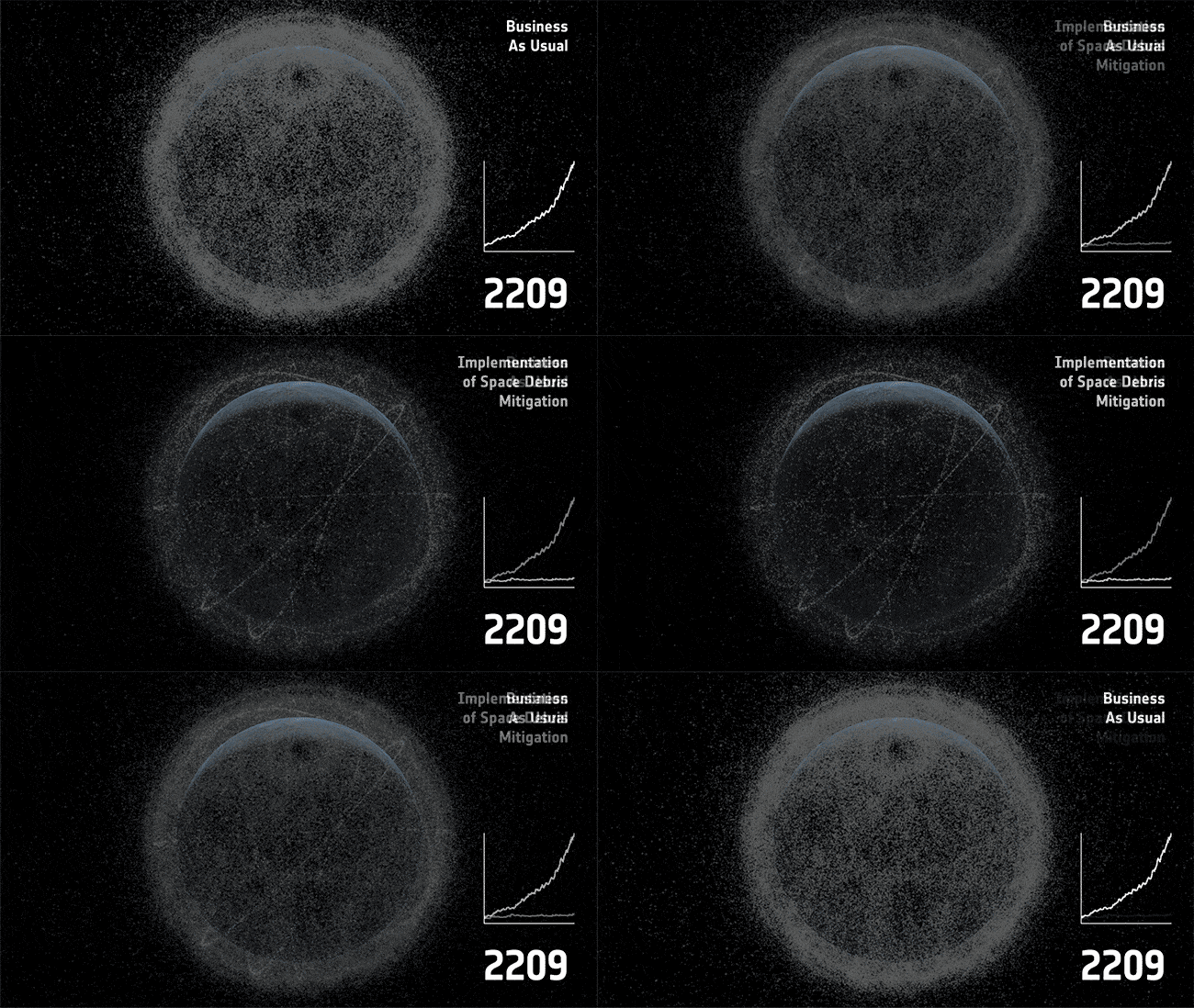
In addition, the ESA’s Clean Space program focuses on active debris removal to stabilize the growth of space debris and ensure that newly launched satellites comply with post-mission disposal guidelines. If left uncontrolled, simulations show that the current arrangement of satellites around Earth will progressively increase objects in low earth orbit. Too many objects in orbit may increase the frequency of space debris collisions (refer to Fig. 1). This describes the “Kessler effect,” named after NASA space debris expert Don Kessler. This could create huge issues for satellites, astronauts, and mission planners. In a worst-case scenario, this may trap humanity on Earth. Fortunately, we have time and robotics capable of decommissioning old or abandoned satellites.
3. Assembly in Space
Earth-built structures that are launched into space are expensive and restrictive in design, weight, and size. However, construction and assembly in space (via robots) could significantly reduce launch mass and stowed volume for space missions. In-orbit microgravity offers a unique setting for the construction of large-yet-lightweight structures.
Space assembly projects may include the construction of spacecraft, habitats, solar cell arrays, satellites, and stations. There are many developments underway to lay the foundation for space assemblies, such as robotic manipulators, navigation systems, guidance systems, robotics interfaces, and docking mechanisms such as those from Altius Space Machines and Oceaneering International. Using these components, space agencies can develop robotic constructor/assembler systems.
Two examples of specialized space assembly robots under investigation include Carnegie Mellon University’s Skyworker and NASA’s SpiderFab. The Skyworker robot belongs to an archetype of robots called “attached mobile manipulators” (AMM), which are identified by their ability to work and walk on the assembled structure. The Skyworker is designed to autonomously transport and manipulate payloads of differing weights and sizes while also deciding on its optimal posture according to each assembly task. SpiderFab, on the other hand, integrates additive manufacturing (i.e., 3D printing) techniques with robotic assembly (along with metrology sensors and thermal control techniques) to create spider-like extrusions of desired structural elements. The robotic legs then manipulate and bond structures together like a spider spinning a web. NASA’s investigations have shown that SpiderFab could offer considerable savings for the assembly of solar arrays, radio antenna reflectors, and other structures in orbit.
While developments are still few in this area, it’s clear that the advantages of in-space construction are great and may soon spur the widespread adoption of space robotic assembly technologies.
Automated Systems
When ground controllers on Earth send communications to systems in space, there’s often a lengthy delay. Automated and semi-automated robotic systems, however, can operate with significant autonomy due to the fact that they don’t have to wait for a signal. Already, these robots—satellites, telescopes, probes, and relays—are found in various orbits throughout the solar system. Many such systems are used for imaging and analysis, while others offer telecommunication assistance. Some examples include
- the ESA’s Mars Express,
- NASA’s Mars Reconnaissance Orbiter,
- the Hubble Space Telescope, and
- the James Webb Space Telescope.
The Mars Express was originally a two-part program. In part one, the Mars Express orbiter entered Mars’s orbit to release the Beagle 2 lander. The lander was intended to perform exobiology and geochemistry research on the planet. Unfortunately, Beagle 2 failed to fully deploy when it reached Mars; however, the Mars Express continues to carry out comprehensive research on the planet’s atmosphere, surface, and moons (i.e., Phobos and Deimos). Similarly, the Mars Reconnaissance Orbiter was sent to Mars’s orbit to identify potential landing sites for future lander missions and act as a telecommunications relay between landers and Earth.
The Hubble Space Telescope was launched in 1990 to study the universe from low Earth orbit, primarily via optical and ultraviolet wavelengths. While it was later succeeded by the James Webb Space Telescope (see below), it is still in operation as of this writing. It’s powered by an array of solar cells and batteries and uses computers to automate imaging, spectrograph measurements, and telecommunication efforts.
The James Webb Space Telescope (JWST) was launched on Christmas Day, 2021. The JWST primarily views the universe through the infrared spectrum with a much larger mirror array. Fig. 2 shows a comparison between the two space telescopes, looking at the same SMACS 0723 cluster of galaxies. While the Hubble Space Telescope can view incoming light from the universe up to 13.4 billion years into the past, the JWST can view incoming light from the very first stars—13.7 million years in the past. Thus, we can see into the past—the light coming from distant stars may have traveled millions of miles to reach us, but by the time light reaches the telescope, the star itself may have died.
In January 2022, the JWST reached Lagrange point L2 in its three-body orbit around Earth and the Sun. It then commenced automated calibration of its mirror arrays using high-precision micromotors and sensors and a predetermined star system as a reference. Since its calibration, the telescope has offered us some extraordinary views of the galaxy.

What’s the Event Horizon for the Space Robotics Industry?
The future of humanity’s exploration and study of space via robotics will continue until technology advances enough for humans to traverse through cosmic radiation and other hazardous settings safely and reliably. Until then, robots will continue to explore and observe space (and other celestial bodies); maintain and clean up artificial satellites orbiting Earth; and form new construction and mining industries in space.
To ensure that our robotics are up to the task of propelling humanity’s footprint into the solar system and beyond, we need to continue to develop new technologies in the fields of robotics, mechatronics, advanced materials, advanced manufacturing, space technology, and more.
Companies in these areas often seek ways to overcome competition and gain funding, licensing, or acquisitions. As an external marketing agency focused on science and engineering, High Touch Group understands the industry better than other agencies. We help companies stand out from their competition and connect with potential customers and private or public funding bodies.
About High Touch Group
High Touch Group has deep roots in aerospace, space tech, and robotics/automation industries. We work closely with VCs and government agencies that seek to fund (or currently fund) leading-edge aerospace and space tech projects. Our aerospace and space clients have enjoyed exposure in science-forward podcasts, peer-reviewed journals, magazines, social media, and more. We formulate powerful marketing assets, including trade show presentations, webinars, websites, and marketing collateral.
Contact High Touch Group to find out how we can propel your company to new frontiers.


